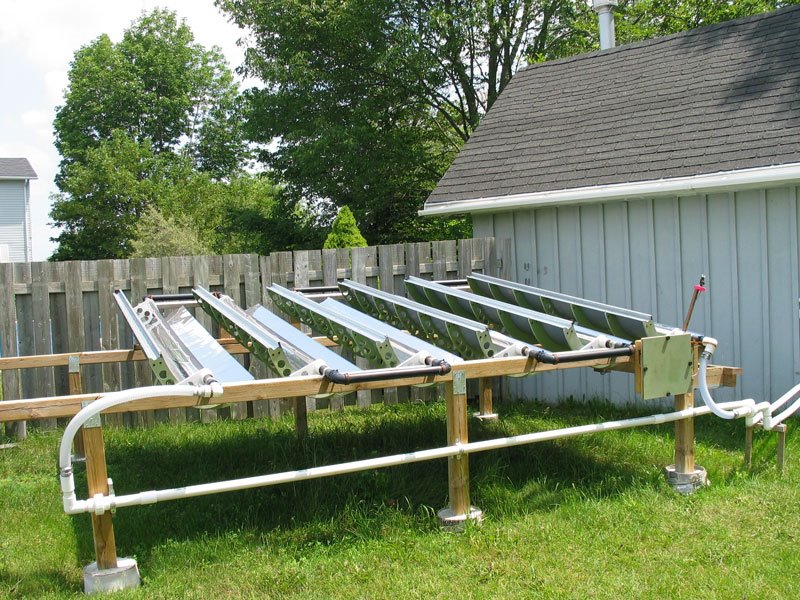
Click on any of my pictures for an enlargement or click
here to see an animation of the array tracking the sun over a full day in less than a second.
My solar parabolic collector array now tracks the sun automatically. It's been working reliably for about the last couple of weeks. The improvement in heat gain is pretty remarkable as I don't have to be around to point the collectors at the sun as it moves across the sky.
I'm working on several tracking control strategies. Currently, I am using a small device available from Duane C. Johnson, Red Rock Energy (
www.redrok.com) and I like it. Duane has a large and very interesting website with tons of suggestions and technical ramblings. I'm using his LED3X to control a similar
Grainger gearmotor to the one he recommends. My gearmoter runs a screw shaft which moves the reflectors. On last year's prototype, I'd missed his suggestion about the extremely low gear ratio required and consequently my prototype was missing the sun and hunting constantly. Lower gear ratio, mine is about 6000:1 overall solves the problem.
The advantage of the LED3X is that it is small, ready made and inexpensive, about US$35 plus shipping. I bought three to have a couple spares for experimentation and in case of failure. Red Roks's delivery by post was prompt.
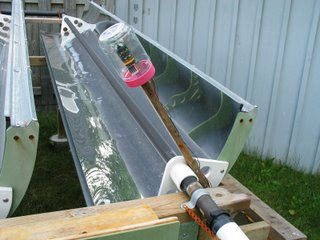
The hookup is simple. LED3X requires connections to the motor, a couple of limit switches and the battery. LED3x is mounted in the plastic peanut butter jar on the stick.
The Jiffy peanut butter jar radome is actually one of the Red Rock suggestions, although my jar isn't large enough to accomodate the LED3X sideways, so that it "sees" the sun through the side of the jar. The bottom of the jar distorts it's view of the sun and causes positioning errors. My arrangement is also hardly weatherproof and only a temporary solution for me. On clear days, I remove the jar and just leave the LED3X to operate in the open.
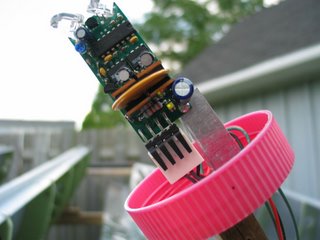
It works great. The two fat LEDs at the top sense the position of the sun and drive a MOSFET H-bridge to send DC current through the motor in one direction to go east, or in the other direction to go west. See Duane's website for a complete explanation of how it works.
The LED3X works in short "bursts". The motor will run for a while in one direction or the other or sometimes in both directions in the same burst if it is close and senses that it has overshot. Each burst is a few seconds long.
Because of the high gear ratio, you don't really see the reflectors move during each burst but after a series of these bursts, slowly but surely the reflectors move into position. When either of the limit switches is reached (west or east) it stops trying to move in that direction, but can move in the other direction. The limit switches stop motion at the extreme ends without damaging the motor or reflector linkage since the geared down motor while very small is extremely powerful.
The timing between the bursts is adjustable using the tiny blue control at the top left of the LED3X. You can have it constantly in motion where the bursts occur almost continuously or up to several minutes or so between the bursts. I have it set to about 30 seconds between the bursts to conserve battery life.
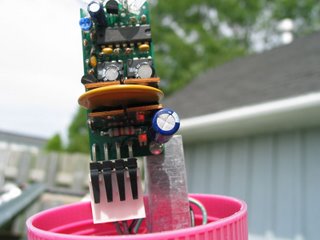
In the bottom right corner of the LED3X, you can see a tiny bi-mode green-red LED. This is GREEN when the motor is turning the array EAST (picture above) and RED (this picture) when the array is turning WEST. Otherwise the LED is OFF between bursts. This provides a useful diagnostic to let you know what is happening.
One of the things that I don't like about the LED3X is that it runs the motor during every burst, even if the array doesn't need to go anywhere. It will start to run in one direction and then reverse and go back. In my mind this wastes battery power, but it's minor. The motor draws only about 100mA from 12 VDC. The burst length is not adjustable but the timing between them is. You can set the bursts further apart to save power.
Another behaviour that is a bit annoying is that when the weather is cloudy, the LED3X runs the motor and sometimes moves the array quite a bit off target. Of course, when it is hazy or cloudy, it can't know where the sun is. But again, to save a bit of battery power, wear on the motor and to avoid guessing incorrectly and moving off target, in my mind it should just stop commanding the motor.
One last quibble with Duane's device, which otherwise I am very pleased with, is that because of the bursting behavior, it takes quite a while in the morning (about half an hour in my case) to move from it's resting position in the west back to the east to catch the morning sun. Of course, if I didn't have the bursts set quite so far apart, it would swing over much more quickly. But the sun is not very hot in the morning anyway, so this is not a big deal.
Yesterday was a particularly hot day here in Southern Ontario with the temperature in the shade over 95 degrees F. At the solar peak in the day, about 3:30pm, the water returning to the pool reached 85 degrees. The pool temperature has reached 80 degrees. It is a big inground pool, about 32 by 18 feet and about 10 feet deep. Quite a lot of water to heat.
Our pool has never been this warm, even when we did allow ourselves to use the propane gas heater.
I have more improvements in mind as I watch it work and will be adding more collectors in the coming weeks to increase the heat output. The sterilizer is yet to be installed.

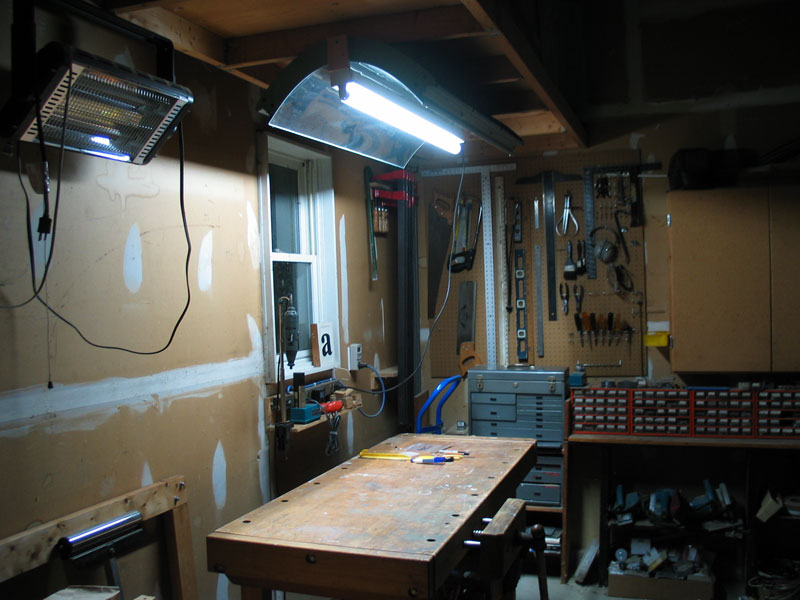 I had made up a number of four foot parabolic solar reflectors for prototyping the solar heater project.
 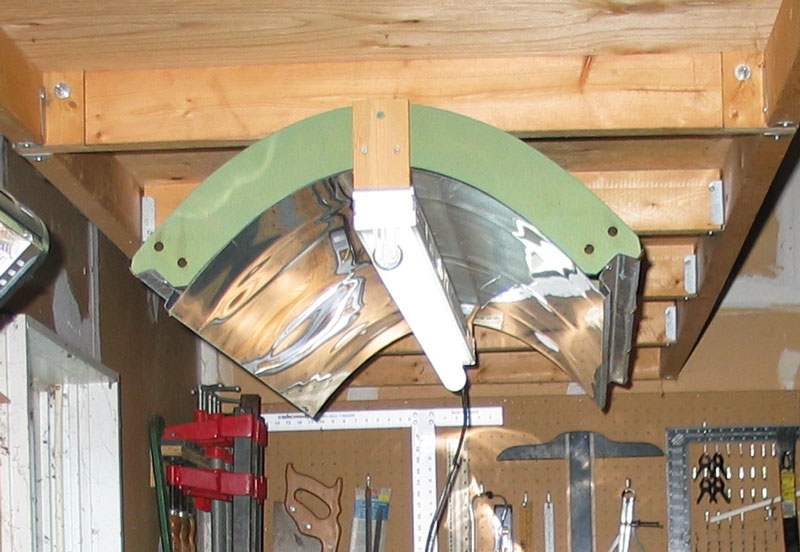 I haven't done a scientific test against a two tube fixture without a reflector, but I'm very pleased with the even and bright lighting of the bench surface and delighted to be using half of the electricity of a two tube fixture which I might have otherwise used without the reflector.