Wednesday, January 14, 2015

uses for phragmites

Phragmites (pronounced "frag-my-tees" or \ frag-ˈmī-ˌtēz \, pronounced, here commonly called "frag") is a fast growing perennial wetland grass native to Eurasia and Africa that is now established throughout the world including my own region of southern Ontario, Canada. Phragmites thrives in roadside ditches as pictured here near Limehouse, Ontario and along waterways and freshwater coasts. Here it is considered an invasive pest with no uses, to be eradicated if possible. But it does have uses.

(click on pics to enlarge) I was surprised to learn that phragmites stalks are very desirable materials to be used for roof thatching, to build roofs with a claimed life of 60 to 80 years! Thatched roofs are not at all common in Canada but are used in similar climates in northern Europe (like Finland) where the reed is also plentiful.

This excellent video from the COFREEN project describes the harvesting and use of phragmites for roofing, insulation and heating fuel.

Phragmites australis is also known as "water reed", "common reed" or "Norfolk Reed". Knowing these alternate names is important when looking for information about the thatching craft or phrag info generally.

In the UK, thatching is described as a growing business with the number of thatchers having increased from about 200 to about 1500 over the past 45 years (info previously at thatch.org now gone, website seems under construction "coming soon"). You can locate UK thatchers.

In this classic text "The Thatcher's Craft" Rural Development Commission, London, 1960, the specific use of phragmites (as "water reed") is covered in detail. (a previous link to the entire 234 page text is now gone. Now I can only find this 22 page version)

In the the Wikipedia entry for phragmites, uses are covered in section 6 including phytoremediation water treatment. Additional uses are as a craft material (for basket and mat making, paper, musical instruments), fences, cattle pens, fishing poles, spears, food (both human and animal) and bee keeping.

The Purdue Crop Index on phragmites gives additional uses for cattle grazing, as feedstock for rayon and board making, "a fine fibrous material suitable as a filler in upholstery", rope making, partitions and brooms. Food and folk medicine uses are also described.

Use of chopped, freshly harvested phragmites for biogas production with the by-product (sludge) spread on farmland in Sweden is described in this book.

Phragmites is harvested and sold commercially in China, presumably for roofing.

When you have lemons, make lemonade!

Thank you for your interest.

George Plhak
Lion's Head, Ontario, Canada

Update April 7 2015: Phrag seen in healthy patches along my route to southern Ontario. These shots of phragmities are near Pearson Airport, Toronto. Along the west Dixie Road side.
I have not seen any of the ultra tall variety yet.
Update Feb 24 2019: Search "biochar phragmites" to see recent work on producing Biochar from phragmites like this study (.pdf) from Western U in Canada

See additional notes in the comments below. Also minor edits and fixed some links above.

Sunday, December 28, 2014

your library has tools

I found that my local library has energy monitoring tools available to borrow. You should check at your own library.

I recently learned that it is possible to borrow a thermal imaging camera and other renewable energy tools from the Medicine Hat Public Library (see this from the Medicine Hat, AB HATSmart).

Other tools mentioned are an infrared thermometer, a power cost monitor and a watt meter. They are loaned like other library assets, handled with the normal system.

These are tools that the average homeowner might use if they were aware of how to properly use them to spot energy leaks. Some, like the thermal imaging camera, the average homeowner likely would not buy for their own use because of high cost. Rentals are not commonly available outside the "big city". Borrowing from the local library makes a lot of sense.

Were such tools available from my own library system?

I asked Erin at the local Lion's Head, ON library yesterday about borrowing renewable energy tools.

Erin showed me an electrical monitor which I borrowed to compare to my own (kill-a-watt). They have one of these Trickle-Star units in a kit with some useful publications at every branch through a program sponsored by Westario Power. Two Westerio publications "Energy Conservation Handbook" and "Energy Monitor Loaner Program" as well as the Trickle-Star user manual are included in the loaner kit.

Erin thinks they have one of the IR spot thermometers available.

Interestingly, she was not sure how to look these things up. On my library receipt, the call number for trickle-star is "BCPL energy monitor", the title is "Energy monitor loaner program". I have it for a week and will do some testing with it. You can reserve it through the BCPL on-line library.

My library also has a geocaching kit complete with GPS that you can borrow and there is some talk of buying a 3D printer!

The Medicine HAT Smart website has lots of useful information and is worth having a look.

I would be interested in what you find at your own library. Please use the comment form below.

I came across Medicine Hat while reading about the new Medicine Hat first concentrating solar power plant in Canada.


George Plhak
Lion's Head, Ontario, Canada

Your comments are always welcome. You can use the form below (comments are moderated and will appear a short time after you post - prevents spam)

Friday, October 24, 2014

weatherproof rotation switches from recycled thermostats

A good source for rotational switches can be had in old thermostats which contain a mercury switch or two.


An old thermostat contains a mercury switch which you can use to sense mechanical rotational position. This is especially valuable for outdoor projects since the switches are sealed. I am intending to use these for low voltage (about 12 volts) control where the switched current won't be more than an amp.

I am replacing 80s technology with recycled 90's tech. At my house, I have replaced the existing clock motor thermostat (the clock did not work) with a "new" (to me) Honeywell/34 that had been removed from a church. The date on the "new" manual is 1994. According to the manual: this thermostat is actually a small but powerful computer. So far it is working fine. The default temperature of 20C is a bit too warm but nice as I enjoy the heat while it is not too cool outside. The furnace is not working hard yet, the outside temp is about 5C. Replacing a thermostat is best done on a day when you don't actually need the heat.

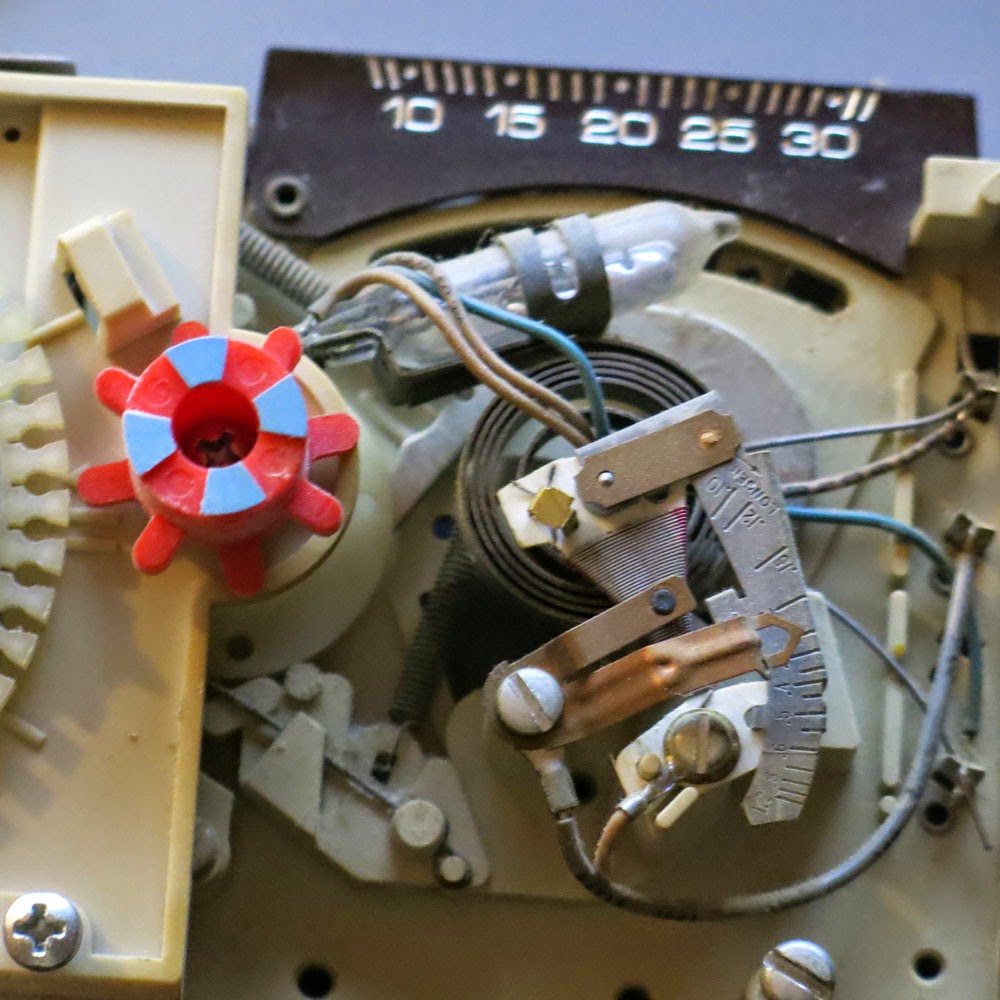
In this old Honeywell Chronotherm the single mercury switch is to the right on a tilt-able mount which is attached to the set temperature lever. The black thing with two wires hanging out the left side looks and feels like a battery. Is it possible that is a DC operated clock?

A closer view of the mercury switch, the small glass vial up and to the right to the right of the colored plastic post. I would like to remove the vial and it's wires without damage. I'll have to study it a bit and report back.

SAFETY REMINDER: Mercury is toxic and we must take a lot of care NOT TO BREAK THE VIAL and let the mercury escape. It is best to work over a pan so that should the vial be damaged, the mercury will escape into the pan. Keep a pill bottle handy for any escaped mercury metal.

In North America, you are more likely to see round Honeywell thermostats, like the T87 (complete data sheet here). It comes apart easily by undoing the single long screw that holds the adjustment post in place.

Recently, I rescued three T87 from a lighthouse that had new heating installed. Thank you Cabot Head. Three is ideal since if I have trouble with any one I will still have the two I need.

When I removed these from the wall, I did not know that there were three screws to remove the dome from its base so some damage resulted, mostly to a metal wiring terminal post but that won't matter for removal of the mercury switch.

Here is the T87 dis-assembled with the mercury switch on its thermal spring. The wire terminals are clean and undamaged. The drop of mercury is in the glass vial which is not chipped or cracked. With this one, the glass vial can be separated from the mounting clip, it just slides out the fingers, they haven't used any glue. But I think that we can make use of the clip assembly to mount our mercury switch.

Could we use the whole tilt-able mount assembly to have a fine adjustment built in to our own mount? For what I have in mind I don't want temperature to be a factor so I would like to replace all or most of the bi-metal spring which is the sensing element for temperature in this thermostat. Newer ones use a thermistor or a semiconductor sensing element and they don't contain a mercury switch.

One possible use of these type of switches is for limit switches in a solar tracking array or for a float switch.

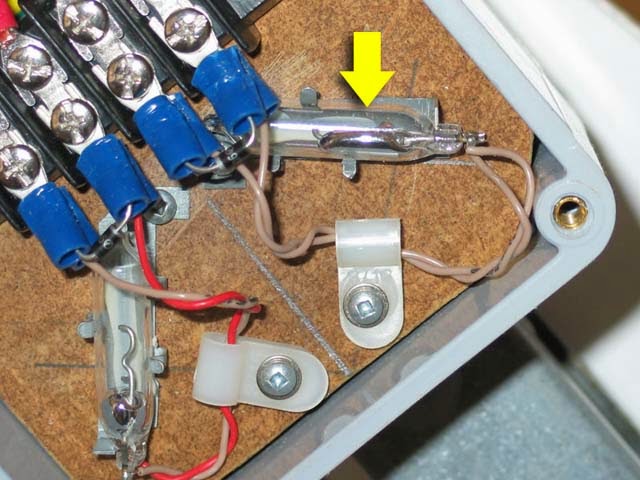
Mercury switches (in the box at the red arrow) are used to limit the rotation of the array in the pic of a parabolic solar collector.

Two mercury switches cut off motor current when the array tilts over as far as it should go. To go further will cause metal parts to jam together. Stalling the motor uses a lot of power uselessly so it is best to avoid hitting the mechanical limit. The mercury switches help prevent that.

It is not possible to easily buy mercury switches since they have all but been banned for new construction. However by gathering these as they are being removed from service saves them from the landfill and keeps them available for a future use.

Link here goes to the motor drive of the project. The main index is diy solar parabolic trough gen2 intro

George Plhak
Lion's Head, Ontario