

I believe that just because something is older, it isn't necessarily useless or bad. Sometimes old is good and even better than new. Particularly these days when new has come to mean cheaply made, unrepairable or throw-away.
There are many older machines that with a bit of care, repair or restoration can be made to function as well as when they were new, or even better in some cases than the "latest and greatest".
In many cases, knowing what you have, what you need and how to use it are more important than having the very latest. Keeping older stuff going longer not only can cost less than getting new, but it also keeps it out of the landfill. In many cases, older machines discarded by others can be had for free or next to nothing. I am often amazed by what people throw away.
Take my snowblower above for example. I purchased someone else's trade-in for $250 at a local shop. This 1960 something "Snow Bird" is probably one of the first such snow throwers available. It has the original Briggs and Stratton L-head 6 hp engine and most of its original parts. There is only one speed and no safety devices at all. We call this little tank "Annie" (after Canadian singer Ann Murray's big hit "Snow Bird"). This is Annie's third year helping us keep the driveway clear of snow and as I learn more about her and make various repairs and renovations, she just keeps getting better and better.
Post script - Annie died and was replaced with a much newer and very much more functional machine. Sometimes one can go so far back to be noticably less functional. Anne was noble but only had one speed. It was, after all, much harder in the old days!
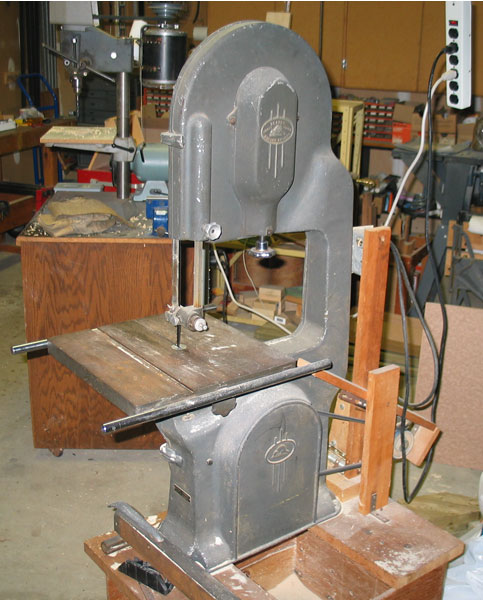 One of my other favorite older machines is a "Beaver" 14 inch bandsaw purchased from a local cabinet shop that was downsizing for $200 about 20 years ago. I installed new bearings and guides then and once in a while, I clean the sawdust out of the original electric motor. This fine machine has done many projects for me including the production of the reflector ribs for the solar parabolic heater. Produced in Guelph not far from here, probably in the 50's, before Beaver was consumed by Rockwell who then knocked down the factory and moved production to the orient. With a bit of care, this sturdy machine will probably still be cutting wood many years from now.
The newer bandsaws look nicer but are not, in my opinion, anywhere nearly as solidly built as my old Beaver. Certainly they don't cut wood any faster or cleaner.
Of the three cars in our family, two have over 280,000 km and the other has just passed 160,000. They look good and run well and get us where we need to go. None of them are SUVs. Changing the engine oil very regularly and generously replacing or fixing the parts that break help to keep the three machines going strong. For what I cannot do myself, I have a good mechanic I can trust. Good sources on the web for information about these vehicles are generally NOT the manufacturer's websites, but third party sites set up and maintained by like-minded owners. For the VW, I particularly like www.vwvortex.com which contains fabulous do-it-yourself information specific to that car.
Sure, they will "wear out" eventually, and rust from the road salt used in our climate eats the metal and can't be stopped but I am determined to keep them running reliably as long as I am able to do so.
I feel the same way about my computing machines. One of my current projects is a matched set of three identical 200MHz Pentium computers running Windows 2000 sp4. The parts came as trade-ins from a local college that was upgrading machines I built for them only six years ago. New inexpensive cabinets, power supplies, fans and hard drives were added and new clean installations of Windows make these machines run like new at very low cost. Having a spare computer or a matched set of two or three can be extremely useful for experimenting with software or hardware before adding it to my "production" systems. More about that project later.
I feel that many people buy new computers because their older machines are "too slow". For most uses, we do not need the processing power that is currently sold and the reality is that our machines are often bogged down with adware, viruses and the debris of programs that did not uninstall properly. It is absolutely amazing the new lease on life that can be had by simply cleaning the drive and reloading Windows onto an older machine.
 It is also important to open the case once a year or so and clean the dust out of the fans and check for fans that have stopped working. I once had a customer who brought back her one year old machine complaining of a noise it had developed. I found that the cooling fan on the processor was completely clogged with pet hair and it was the fan turning against the mat of hair that was making the noise! It was easy for me to clean out the hair and restore cooling to the machine. The normal environment of many computers (near the floor) makes them susceptible to collecting dust and getting clogged cooling which can lead to intermittent problems and failure. You don't need to have pets for this to happen.
For a machine that is to be connected to the web, I religiously add anti-virus program like Norton Internet Security or McAfee and keep them updated. The price for me is that the anti-virus software takes more space on the hard drive than Windows and consumes a fair amount of the computer's power just looking out for the bad stuff. This is an incredible waste but an unfortunate sign of the times. For this reason, I isolate my production machines from the web and do not use anti-virus software on them. They are much faster as a result.
I am under-impressed by the "improvements" in the latest Intel product line. Intel has rediscovered the importance of keeping electronic machines cool and the desirability of using less power, as if this was news. Just when we get the bugs out and figure out how to make a reliable system, Intel changes the processor pin-out, the chip set, the cooling and the power systems so that interchangeability is difficult or impossible. If it breaks, you are supposed to throw it out.
I feel that one of the finest mainboards ever made was the ASUS P4C800E Deluxe. It had a production run of about a year and has been "obsolete" now for about a year. Others must feel the same way since these sell on ebay for about the same cost as when it was new. Having installed about 40 of these, I have found that these make a very stable and very fast computing machine at a reasonable cost. These boards will form the basis of my next matched set.
Most recently, I have been adding to my electronic test equipment lab some of the wonderful equipment made in the 60s and 70s by Tektronix, Hewlett Packard and Fluke. These are acquired on ebay or at swap meets or from the local re-cycling center and restored and repaired and recalibrated as they require to working condition.
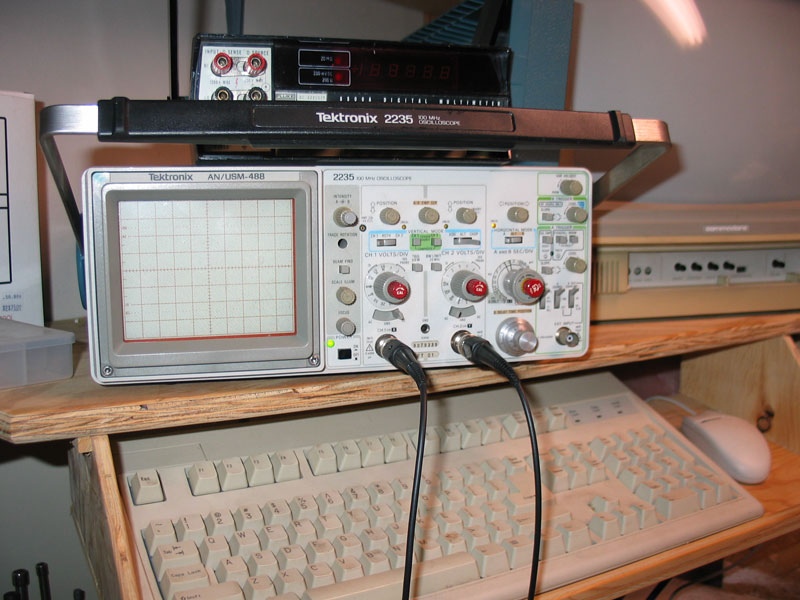 My Tek 2235 scope was used originally by the US Air Force in Texas and was bought on ebay for $150. It works perfectly and is almost as new. It is a thing of beauty to me and 30 years ago probably cost thousands of dollars. I was able to get operating and service manuals easily at low cost in case it ever breaks, or I can probably just buy another one at low cost. These older test machines measure volts amps frequency and waveforms as well as the current equipment, at least in the ranges that I work today. Repair information and users groups exist on the web for this fine, well known equipment.
My digital camera is a Canon G3, bought from a customer at low cost when he got his new G6. Like new, it is way more than I need for my work. My video camera is an original Canon Optura DV, out of production about seven years ago and working beautifully today with a bit of care.
In case I sound like a technological luddite, this is not the case. For most of the last 40 years, I have tried to stay near the forefront of "high technology", often being one of the first to have the newest. Looking back, I see that this has cost me a lot of money and resources.
With my teenage part time earnings in the early sixties, I bought one of the first germanium transistors, the Raytheon CK768. With it I built a speaker amplifier for the crystal radio I had built the previous year. I learned how to program on one of the first IBM 360 machines at the University of Toronto in the late 60's using punch cards. Like a few hundred others I bought the kit and built the first available personal computer: the MITS Altair in 1975 and in fact met Bill Gates of Micro Soft (as he called it then) at the first (and I think only) World Altair Users Conference at MITS in Albuquerque. My business through the 90's involved editing video on computers which was technologically challenging at the time.
With the deluge of inexpensive goods from China and India, I see that we have given away our manufacturing capability in North America. Worse, we have acquired the mentality that our older equipment is no longer useful to us. We no longer teach electronics in high school. The newer stuff isn't really repairable since it isn't designed to be repaired, it is designed to be consumed and thrown away. Service information and parts are not available. People who know how to work on the newer stuff are not common. The powerful global corporate marketing machines force feed us the new features which we can't (or mustn't) live without. The old stuff goes out with the rest of the trash. In many cases it is difficult, impossible, or uneconomic to break down to recycle effectively or safely.
This is a trap for us.
The economies of the east grow as we "consume" their goods bought at artificially low prices, but the prices will rise much higher. Lead by their "consumption" of oil and raw materials, we are already suffering increased costs of almost all goods that must be transported. Soon the cost of the manufactured machines will rise even higher and our economy will falter as we are less able to "consume". We will be forced, by economics, to keep our older stuff running longer. We should get ready for that. Besides, I very much resent being called a "Consumer" and we are already having trouble getting rid of our garbage (old stuff).
This will only get worse.


