Showing posts with label opinion. Show all posts

Tuesday, June 22, 2021

fixing old stuff

Troubleshooting two big old Tektronix 7854 in my garage. The first analog oscilloscope with a computer. An oscilloscope lets you "see" electricity.
 
Currently I am checking the LV power supplies. I think I can operate them completely out of the scope.
 
I hope it will be an advantage to be able to compare one scope to the other. I have already found a few things
 
I have the 3" thick paper Tek manual with beautiful foldout diagrams and all the update pages (late issue).
 
And I have a third working 7854 on a cart in the house. I can always open that one up too :)
 
Why do this?
 
These scopes might be forty years old. A modern $400 oscilloscope from China does more, better, smaller, lighter, and is way cheaper (but probably not with 400MHz bandwidth).
 
The 7854 was introduced in 1981 at a base cost of US$10,500. In my 1987 Tek catalog it lists for $16,220 but by then included the waveform calculator and the extra memory option. Project Leader on this scope was Tom Rousseau. More about Tom and the 7A26 amplifier.
 
 
Thanks for your interest.
 
George Plhak
Lions Head, Ontario, Canada


Wednesday, May 19, 2021

easy change


John Deere Easy Change oil system

Today I tried to change the "Easy Change" oil filter on my cute little John Deere E120 lawn tractor. I am supposed to easily remove a canister that contains the filter and about a third of the engine oil and replace with a fresh unit. No need to drain the oil, they say. Cost locally at Home Despot is C$70. They call it Easy Change. First time I have tried it. It was anything but easy.
 
Normally, an oil and filter change takes about a hour if done carefully and costs about $20 with good quality oil and filter. Virtually all of the engine oil gets replaced with new, not just a portion.
 
But I am stuck. The old canister came off with some effort. Push and turn counterclockwise they say. Difficult to remove but it seemed to come off OK.
 
The new filter did not lock into position as it should. It is in the middle and it is really stuck. There was a click but I cannot remove it or force it to the fully locked position
 
In a conversation this morning with my local JD dealer 1 hour away they say "put the tractor on your trailer and bring it in. We will get it off for you while you wait". Thanks. I don't have a trailer.
 
<more conversation with the dealer>
 
I am going there tomorrow to get the parts to remove the "Easy Change" oil filter system and replace with a conventional filter and drain port.
 
JD equipment with an Easy Change oil system can be fixed. 
 
It is a bad idea that can be retrofitted for less than the cost of one canister.
 
Big Thanks to <my local JD dealer> for help.
 
Thanks for your interest.

George Plhak
Lions Head, Ontario, Canada


Wednesday, March 11, 2020

battery testing 3

Retesting after 6 months of daily use shows ~10% decline in capacity of my 18650 lithium rechargeable cells.

Last summer I tested three new 2200mAh cells. Initial average capacity was about 2030 mAh with my test which may or may not be accurate. After six months in service, I repeated the test with the same tester and method and found average cell capacity was now about 1822 mAh, or a reduction in capacity of about 10%. Raw data is here.

I attribute the reduction in capacity to my daily usage of the batteries although there could be other causes (* below).

The squiggle (~ tilde) before the 10 means "about" and that is really the theme of this post. Often in amateur science and engineering we need an approximate answer to check a hypothesis or opinion. Some quick measurements, even if approximate, are better than no data at all. Hence the "about". Sometimes repeatability and consistency may be more important than absolute accuracy when we are trying to compare.

In the case of these batteries I had tested for capacity about six months ago. Since then I had used these batteries daily in a vape pipe. They seemed to be performing well. Typically I would switch a battery sometime mid-day putting the partially discharged battery back onto the charger and inserting one of the two other charged batteries into the pipe. So I knew two of the three batteries went through some sort of discharge/charge cycle daily determined by my vaping habit with was pretty steady during the six months. I tried to randomize which battery I did not use each day but wasn't entirely careful about that aspect.

Since I had not used these PKCELL 2200mAh batteries before, I was curious if there was an effect on battery capacity and how much it might be.

Why go to the trouble of testing? I paid about Cdn$15 each for these cells. Some have been junk. I am accumulating things which use 18650 cells and had other applications in mind so I will need to buy more. The best way to determine capacity is to measure with a controlled test.

Initially I had tested each battery three times. Three data points. I like three. With only two measurements, if something goes wrong or varies, it may not be apparent in the data. The two measurements will differ always. With three measurements, hopefully two will be more similar than the one which varied. Ideally all three would cluster tightly. More measurements would be even better but we are after an approximate answer so three is good.

I tested with the same ZHIYU ZB2L3 v2.3a tester and the same 7.5 ohm resistor.

There is a new version 3 of the tester which I have ordered.

[click any pic to enlarge]

I considered changing the load resistor. I am simply using one of the two resistors that came with the kit. Readers will notice that I changed the arrangement of the load for the second round of testing with auto batteries to create a heavier load. I'd like to more closely match the 1C rate that the manufacturer has used for determining the branded 2200mAh rate. But at this point that is less important to me than using the same test and load to compare batteries from different manufacturers or different batches from the same company.

I have recently done initial testing of two new batches of 18650 batteries: four more of the PKCELL 2200mAh and two bright pink Samsung cells, the best I've tested so far! All tests with three repeats each.

Thank you for your interest.

George Plhak
Lions Head, Ontario, Canada

* Other causes - I knew you'd ask. Hypothetical causes really, but possible. Like maybe the batteries have some manufacturing defect that causes them to loose capacity independent of charge/discharge? Or maybe I stored them in a hot car in the sun? I did not, with these batteries, but four similar cells are installed in two emergency flashlights in my cars. Not used at all but subject to some extremes in temperature. I might retest those cells another time.

[The next day] Another possibility why the measurements this time are lower. I had forgotten but was reminded by the photo I used above: I wrote that I was not happy with the battery holder and had ordered a different type. After the new holder arrived, I installed it with shorter, larger gauge wire as you can see in the pic. This is the tester and holder used for this series of tests, on the right.

So it is likely that the resistance of the output load circuit is now less particularly because of the shorter beefier wire. The holder contacts also look more substantial and are well soldered to the wires. Lower load resistance would increase current (the C rate) and reduce mAh measured. Would it be ~10%? I don't know. I should measure! That's the original battery holder and wires to the left.

I won't go back and retest with the thinner wire. But when I retest the latest cells, I will be comparing them to the results from this tester. That's the importance of consistency.


As is my custom, this is not a paid review nor do I receive or solicit any product in return for writing. I am not selling these products. Just ideas. I don't get a commission. I don't show ads. I don't have a fundraising or patreon page.
I write in the hope that this is interesting or useful to you.
If you would like to show support for my independent work,
please consider commenting or buying one of my books? Thank you. George

Wednesday, December 14, 2016

my typical electrical day winter

INDEX to the series

It is winter here in beautiful Ontario, Canada and I am studying my electrical usage with my utility supplied smart meter. When I called in 2007 asking for one of these, I was quoted about $3K. I didn't buy then, now I have one supplied for me. I am trying to learn from it. I showed my usage this summer. I described the study I am a part of.

It seems to me that there will have to be a bigger incentive for people to pay more attention to their demand for electricity. Our electrical system has huge costs to deal with peak use. There has to be a better incentive for us to pay more attention to this issue. Are we emphasizing the supply side (solar, nuclear, wind, water, storage, etc) of the equation?

Personally I am not unhappy with my own electrical bill. The Ontario government is asking for comments. I read the LTEP (Ontario Long Term Energy Plan) and I think the approach described is sensible under the circumstances we face.

There are huge issues with the system. But good news: we are off coal for electricity in Ontario. Our aggregated demand has been falling for six years which makes renewable easier whatever side of that fence you are on. There are uncertainties that would be helped if we all just paid more attention to our time of use. Little personal changes could make a big difference and many of the issues receiving much attention now would reduce.

I have spent $100 so far and I go off the grid for the peak (of at least I am trying). There are still some problems and not everything works. But this is my path so far. It's pretty painless. I still have rock solid utility grade power when I need it. I am helping out the system. They need me to do this and I am getting ready for the new differential in rates, which will be greater, whatever it is. I think the LTEP is a sensible step forward and gave my comments where I felt I had something to contribute.

I am not being paid or influenced by anyone in the debate. Ontario is off coal. We are actually a beacon. More renewable - of course! Who could not agree.

One other point that we all seem to agree on - using less, especially during the peak yet we don't seem to be focusing on that issue? The demand side - ourselves. I believe TOU will soon become more important us all.

The system is not badly broken. We don't need to be so excited about this issue right now. Let's be a calming voice. My 2cents.

(click any picture to enlarge) Lets look again at the winter picture of my electrical use. I have added some notes to the screen capture. The red arrows show my peak periods, there are two of them now, one in the morning and the other around evening mealtime. I am trying to use less electricity during these periods.

The big spikes W are my old electric water heater. It comes on about three or four times a day at 3KW for about ten minutes. Only the clothes dryer uses more at 6KW. I almost never use it preferring instead an indoor clothesline. When I do use the dryer I reclaim the heated moist exhaust for the house in the winter. In summer, the clothes go on my outdoor line.

At 17:00 the water heater probably hadn't finished heating but it got cut off by the timer. You can see that it comes on immediately at the end of the second peak period, at 19:00.

Here is the summer version so I can compare things. There aren't any W spikes in the red during the winter or the summer so I am successfully keeping the water heater from coming on with a timer. My refrigerator and freezer are also on timers so they are not coming on either but the effect is not as noticeable in the winter because of my oil furnace signature. You will see the furnace marching through most of the day. The furnace uses about 700 watts and comes on every half hour to an hour when the temperature outside is sub zero.

On the winter chart in the period A (the peak), you can see the furnace most clearly since the fridge and the freezer aren't running. Notice how the regular steps of the furnace seem to step down just after 9am? That was a mistake actually. I have added a gutter/downspout heater and have left it ON overnight but it was supposed to have been switched off before the morning peak period started. That heater is not yet on a timer. It uses about 300 watts.

The period B on the winter chart is me doing various things around the house against the usual furnace, fridge, freezer and a toaster oven. The air outside the house was warming up a bit by afternoon so the furnace did not come on as often.

Winter period C puzzled me a bit in that it was completely quiet except for that one mini spike. I had expected to see the furnace running since it is not controlled to stay out of the peak period. Then I remembered that I had turned down the heat when I left the house to go out for dinner. The house was cooling down so the furnace did not come on.

My usage during winter C is about 80 watts which is what I am calling my base load (similar to phantom power). The base load is all the low power things that are always on in my house. The small spike I remember is my garage door opener. I came home briefly and opened, then closed the garage door to look for something.

Periods D and E on the winter chart show nighttime electrical use in winter, a noisy mess of the the furnace, the fridge, the freezer, that one big spike from the water heater coming on. Compare to period C on the summer chart which has only the fridge and the freezer. I learned to tell those apart but with the furnace added, it will be more difficult. I should teach a computer how to do this!

I still don't know usage by individual appliance.


Thanks for your interest
George Plhak
Lion's Head, Ontario

INDEX to the series

Tuesday, September 24, 2013

why two of the same is better

You are never without when you have a backup, a source of spare parts and working knowledge. The latest thing that everyone wants is not necessarily better for you.

I am working on my old radial arm saw - cleaning and tuning. I have moved this saw and all my other tools about 200km so it has been partial disassembled, shaken, bumped and otherwise mistreated. I must check all the adjustments so that it is ready to make parts for my projects.

One of the position locks did not lock. I inherited another of the same model radial saw with my new shop but I like mine better so I began looking at both of them to compare.

If I did not have the "spare" machine, I might not have realized that this funny nut lock thingy (click on the picture to enlarge it) has the tang broken in the center. You can see what it should look like on the one at left. The tang goes into the slot in the bolt and keeps the bolt from turning.

Because I have two of the same thing, I have the good spare part from the spare machine to make mine work properly. DeWalt who made the saw I am sure would not sell this part for a 50 year old saw.

I call this the Principle of Two. I wrote about that here:

http://georgesworkshop.blogspot.ca/2013/02/why-used-is-sometimes-better-than-new.html

The Principle of Two worked for me with my old Honda motorcycle also. I bought a parts bike of the same model and year and used it to learn from and to rebuild my own. Lots of good spare parts. Since that Honda was somewhat rare, I was able to sell bits I didn't need and I think paid for my own.

These old saws are almost being given away on Kijiji. Maybe $80 or "please take it away" so I think when I am finished getting what I need from it, it will go to scrap metal. What a shame. Truthfully, I don't have the room for two of them.

George Plhak

Monday, February 04, 2013

when used is even better than new

Our economy depends on our collective desire to own more, the newer the better. Whatever the sponsors tell us, we want.

But our behavior creates enormous problems for society in terms of credit and waste.

I don't want to lecture about those topics here. Those are well covered.

Instead, I want to describe how I provide reasonably priced high performance computing for myself while making a tiny individual step to slow the waste stream by staying close, but not on, the bleeding edge. This is my small example of thinking differently about consumption.

Buy used to save money is hardly a new idea. But in this case, I hope to show that I am BETTER OFF buying used while having a small eco contribution as well.

Georgesworkshop Principle of Two:

I am better off to have TWO of a previous product, rather than ONE of the current.
or
Two of last year's technology is less expensive and you have backup. (the slide above)

I use "last year" and "last model/product" loosely and interchangeably. I think you'll understand. The principle can apply to a few classes of goods, particularly technology, but not to everything.

How can this be?

  • I am almost as well off, perhaps better off with last year's model. After all, a year has gone by to see if it was any good. Don't you just hate to be the one who buys the dud product, the one that dies in the market? Wait at least a year for other peoples' experience (at their expense) on which to make up your mind.
  • Less landfill If a few people, or a few million people, started to think and act in this way stuff would stay in circulation longer, like good products used to.
  • I can buy two of the last model for less than one of what is on offer today yet be better off in some interesting ways - in spite of not having the latest and greatest.

I have a special memory of my mother taking me downtown as a boy to buy one of the first transistors that became available in the 1960s. Since then I have spent a lot of money and effort on the quest for new technology which taught me:

  • Buying new is expensive. After a year or so, the used price often falls to half or a third, if it has any value at all. Tech stuff generally does not hold any value over time.
  • New stuff can have yet to be identified problems. Better to wait for at least the first service pack or some software updates?
  • The market can cruelly ignore a new product no matter how "good" it seems and it fails. The company can fail too and customers are left with no support. This is too much like gambling to me.

How to cope? I will illustrate how it works for me with a recent computer addition. It is with desktop computers that I think I can give you a perfect example.

My principle of two computers project - a case study

I needed a new main design computer. One with raw power, a big screen with no travel. It had to be a desktop, heavy metal is ok in this situation, a laptop or a tablet just will not do.

My main machine was getting slow and developing quirky behavior requiring lengthy reboots. You will know the signs that a new computer is needed. I had been running this one (and it's spare) for *seven* years doing useful work (amazing?!) and until recently it had been very stable and reliable. One of two ASUS P4C-800e. Both had been excellent. All my files were backed up elsewhere. I was still able to work with it. I decided to migrate before I was forced to.

Instead of ONE new desktop computer I bought TWO IDENTICAL slightly used, for about half the price. Each received a thorough checkout and a OS software refresh on a clean system drive. Each is a complete functioning backup in all respects for the other. There are some interesting ways to use two computers where otherwise you would have one. Here is the comparison as I see it:

One NEWTwo USED
Cost$1000$550 (both)
OSWin8 64 bitWin7 64bit
Raw speed GHz3.42.66
Cores44
RAM GB126
HD GB1500160
Warrantyone year30 days

The column heads have links to the two types of machines I am comparing. The example New machine is from a national retailer, Staples. I am not picking on Staples and this is only an example. Some of the key specs show important differences. Of course these are not equivalent, I am trying to be macro to illustrate a point.

To Compare and Contrast (as they say in high school):

Application software I was not sure if my more important software (Abobe Creative Suite CS3 for example) which I did not have in the latest version (did I mention a tight pocketbook?) would run on a newer OS like Win8. Win7, on the other hand was of the CS3 period and the implication at Adobe was that what I had would not need to be upgraded with Win7 - a possible additional cost of the Win8 approach where I would probably have to upgrade my applications.

I reduced risk by buying only one of the used machines first. I then installed, authorized and tested the bigger packages on Win7 64 bit before deciding to commit to the second used machine.

Performance You will accept perhaps that when the used example was new, only two short years ago (2011), it would would have been then a fine step up from my design computer (2003 3.0GHz P4 running WinXP), the very the same step as I have done now at less than half the cost?

To me, the "new" old machines are a quantum leap from the old XP based P4. I don't honestly think I would have see a difference choosing between the "new new" and the "new old" in performance unless I was really trying to look for it. The contrast with what I am replacing makes it worthwhile.

You might be aware that processor speed, once the ultimate market benchmark, topped out at around 3GHz 10 years ago? Intel realized than it was increasingly difficult to go much faster and instead started promoting other user benefits like "i7-3770"(?). I can tell you that going from a relatively ancient 3Ghz to a much newer 2.66 it is like flying now compared to walking before. There is more to it than just the numbers.

Reliability The used machines have a clean Win7 install patched and field tested in it's 64 bit version. Windows 8 reliability is probably going to be pretty good but do I want to be a tester? Win7 would be safer.

Backup I mean not software but physical backup. Having two identical machines provides an instant available source of backup components - a "hot standby". When you are remote and rely on your computer, having backup is important.

Warranty Having a longer warranty is certainly important for an expensive new piece of equipment. In the used case, the 30 days is long enough to find anything obvious that does not work correctly. Since I have two machines, each can function as a backup for the other. Warranty other than the initial month may be less important to me.

The OS Windows 8 comes on the new computer in the 64 bit version. This must be so even though they don't state since the memory (RAM) provided is 12 GB (more than four, actually three something as the Windows 32-bit sees it).

Windows 7 has been thoroughly tested. I have wanted to try the 64-bit version for some time. Having a 64-bit OS primarily gives the benefit of allowing more RAM. 32 bit versions of Windows (most of them prior to Win8) could address only slightly over 3 GB of RAM. 64 bit allows up to 16 exabytes, (in theory)! I am happy to have the 6 GB offered with the used machines (twice what I had) and I can upgrade each to 16GB for about $100 for both.

At this time, I feel more confident adopting the Win7. I will wait for others to shake down Win8 before I wade in. The change to the Win8 interface is greater for me than to Win7 since I already use Win7 on a laptop.

Cost is a no-brainer for me. Having two of the used is great given the other advantages. Even with add-on RAM and HD to make used and new equal in size and less unequal in cost, buying used is still less than half the price and with a huge performance increase for me.

What to do with the hot spare? After checking the second out, I could quite happily park it on a shelf to keep it handy, un-used.

It could also be set up somewhere as a non-essential spare workstation? A rendering node?

In my case, I will use the second as a non-essential machine for internet browsing and email, functions which I am happy to separate from the main, money making workstaion. I will remove the system hard drive with it's configured and working Win7 and install another system drive and 64 bit SUSE Linux to try that out.

It is very nice to have a spare machine on which to try out new software. You know the kind of software? The kind that you wish that you had never loaded on your important computer? I now have a spare identical machine on which to do tests without any possibility of damage to the operating environment of my main production machine. An off-line hot tester if you like. This is a small but important advantage, and additional insurance of reliability.

Another software benefit: If you are ever wondering about upgrading something fundamental, like the OS, you have an identical spare to test out the upgrade once again without putting production at risk.

The benefit of having an identical hot spare extends to hardware as well. We might all be reluctant to put a main production machine out of service, to pull the wires off or the cover to have a look inside. We would not, with a spare. How many have ruined a perfectly good machine, let's say to try a new graphics card by plugging it in to see if it works? After the smoke clears, rather than fretting about having just killed production, wouldn't it be nice to have just tried the same thing on a risk-free convenient hot spare?

In the event of a gross failure of any of the components of the "new old" main machine, I have an identical working replacement only 5 minute away, by removing it from the spare.

All of this at half the cost of new? To a small business owner or an individual who makes their living from one key machine, backup and near zero failure downtime (not to mention significantly lower cost!) are not just large company IT concerns.

Summary I don't regret not having taken the "new" computer option. I think that in this case, having two of the previous model is perfect - for me.

But I am biased. I do like finer old stuff which can still be useful (like me?:) Please see In praise of older machines. Some of this writing shows it's age and mine. Later in the piece, the ASUS P4Cs I was using in 2005 are the "old" machines I am replacing here. May your own computers be useful to you for at least seven years! But other than fixing some spelling, I left it the way it was in 2005. Dust from the archive.

Thanks for your interest. Your comments are always welcome. Comments here are moderated.

George Plhak

Saturday, December 24, 2005

in praise of older machines

I believe that just because something is older, it isn't necessarily useless or bad. Sometimes old is good and even better than new. Particularly these days when new has come to mean cheaply made, unrepairable or throw-away.

There are many older machines that with a bit of care, repair or restoration can be made to function as well as when they were new, or even better in some cases than the "latest and greatest".

In many cases, knowing what you have, what you need and how to use it are more important than having the very latest. Keeping older stuff going longer not only can cost less than getting new, but it also keeps it out of the landfill. In many cases, older machines discarded by others can be had for free or next to nothing. I am often amazed by what people throw away.

Take my snowblower above for example. I purchased someone else's trade-in for $250 at a local shop. This 1960 something "Snow Bird" is probably one of the first such snow throwers available. It has the original Briggs and Stratton L-head 6 hp engine and most of its original parts. There is only one speed and no safety devices at all. We call this little tank "Annie" (after Canadian singer Ann Murray's big hit "Snow Bird"). This is Annie's third year helping us keep the driveway clear of snow and as I learn more about her and make various repairs and renovations, she just keeps getting better and better.

Post script - Annie died and was replaced with a much newer and very much more functional machine. Sometimes one can go so far back to be noticably less functional. Anne was noble but only had one speed. It was, after all, much harder in the old days!

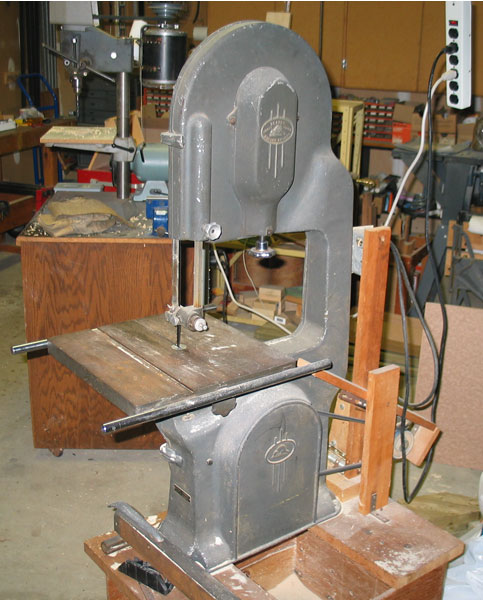
One of my other favorite older machines is a "Beaver" 14 inch bandsaw purchased from a local cabinet shop that was downsizing for $200 about 20 years ago. I installed new bearings and guides then and once in a while, I clean the sawdust out of the original electric motor. This fine machine has done many projects for me including the production of the reflector ribs for the solar parabolic heater. Produced in Guelph not far from here, probably in the 50's, before Beaver was consumed by Rockwell who then knocked down the factory and moved production to the orient. With a bit of care, this sturdy machine will probably still be cutting wood many years from now.

The newer bandsaws look nicer but are not, in my opinion, anywhere nearly as solidly built as my old Beaver. Certainly they don't cut wood any faster or cleaner.

Of the three cars in our family, two have over 280,000 km and the other has just passed 160,000. They look good and run well and get us where we need to go. None of them are SUVs. Changing the engine oil very regularly and generously replacing or fixing the parts that break help to keep the three machines going strong. For what I cannot do myself, I have a good mechanic I can trust. Good sources on the web for information about these vehicles are generally NOT the manufacturer's websites, but third party sites set up and maintained by like-minded owners. For the VW, I particularly like www.vwvortex.com which contains fabulous do-it-yourself information specific to that car.

Sure, they will "wear out" eventually, and rust from the road salt used in our climate eats the metal and can't be stopped but I am determined to keep them running reliably as long as I am able to do so.

I feel the same way about my computing machines. One of my current projects is a matched set of three identical 200MHz Pentium computers running Windows 2000 sp4. The parts came as trade-ins from a local college that was upgrading machines I built for them only six years ago. New inexpensive cabinets, power supplies, fans and hard drives were added and new clean installations of Windows make these machines run like new at very low cost. Having a spare computer or a matched set of two or three can be extremely useful for experimenting with software or hardware before adding it to my "production" systems. More about that project later.

I feel that many people buy new computers because their older machines are "too slow". For most uses, we do not need the processing power that is currently sold and the reality is that our machines are often bogged down with adware, viruses and the debris of programs that did not uninstall properly. It is absolutely amazing the new lease on life that can be had by simply cleaning the drive and reloading Windows onto an older machine.

It is also important to open the case once a year or so and clean the dust out of the fans and check for fans that have stopped working. I once had a customer who brought back her one year old machine complaining of a noise it had developed. I found that the cooling fan on the processor was completely clogged with pet hair and it was the fan turning against the mat of hair that was making the noise! It was easy for me to clean out the hair and restore cooling to the machine. The normal environment of many computers (near the floor) makes them susceptible to collecting dust and getting clogged cooling which can lead to intermittent problems and failure. You don't need to have pets for this to happen.

For a machine that is to be connected to the web, I religiously add anti-virus program like Norton Internet Security or McAfee and keep them updated. The price for me is that the anti-virus software takes more space on the hard drive than Windows and consumes a fair amount of the computer's power just looking out for the bad stuff. This is an incredible waste but an unfortunate sign of the times. For this reason, I isolate my production machines from the web and do not use anti-virus software on them. They are much faster as a result.

I am under-impressed by the "improvements" in the latest Intel product line. Intel has rediscovered the importance of keeping electronic machines cool and the desirability of using less power, as if this was news. Just when we get the bugs out and figure out how to make a reliable system, Intel changes the processor pin-out, the chip set, the cooling and the power systems so that interchangeability is difficult or impossible. If it breaks, you are supposed to throw it out.

I feel that one of the finest mainboards ever made was the ASUS P4C800E Deluxe. It had a production run of about a year and has been "obsolete" now for about a year. Others must feel the same way since these sell on ebay for about the same cost as when it was new. Having installed about 40 of these, I have found that these make a very stable and very fast computing machine at a reasonable cost. These boards will form the basis of my next matched set.

Most recently, I have been adding to my electronic test equipment lab some of the wonderful equipment made in the 60s and 70s by Tektronix, Hewlett Packard and Fluke. These are acquired on ebay or at swap meets or from the local re-cycling center and restored and repaired and recalibrated as they require to working condition.

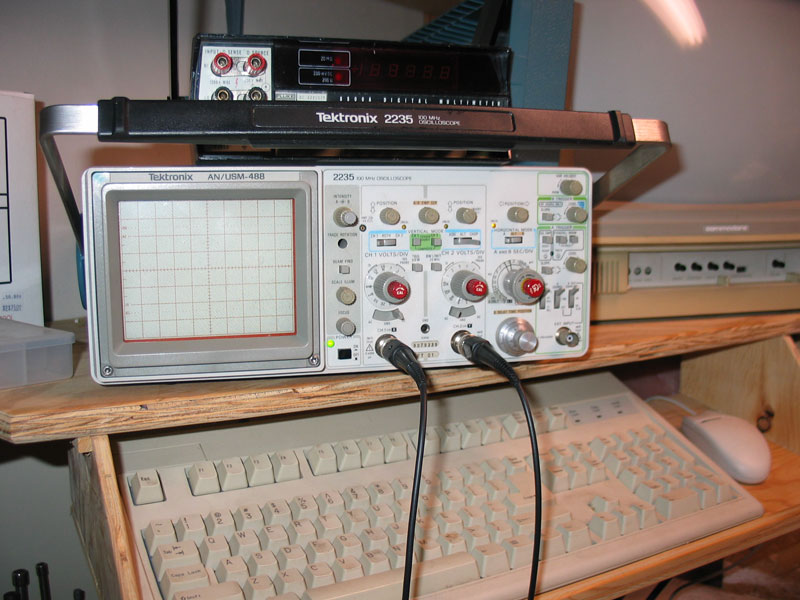
My Tek 2235 scope was used originally by the US Air Force in Texas and was bought on ebay for $150. It works perfectly and is almost as new. It is a thing of beauty to me and 30 years ago probably cost thousands of dollars. I was able to get operating and service manuals easily at low cost in case it ever breaks, or I can probably just buy another one at low cost. These older test machines measure volts amps frequency and waveforms as well as the current equipment, at least in the ranges that I work today. Repair information and users groups exist on the web for this fine, well known equipment.

My digital camera is a Canon G3, bought from a customer at low cost when he got his new G6. Like new, it is way more than I need for my work. My video camera is an original Canon Optura DV, out of production about seven years ago and working beautifully today with a bit of care.

In case I sound like a technological luddite, this is not the case. For most of the last 40 years, I have tried to stay near the forefront of "high technology", often being one of the first to have the newest. Looking back, I see that this has cost me a lot of money and resources.

With my teenage part time earnings in the early sixties, I bought one of the first germanium transistors, the Raytheon CK768. With it I built a speaker amplifier for the crystal radio I had built the previous year. I learned how to program on one of the first IBM 360 machines at the University of Toronto in the late 60's using punch cards. Like a few hundred others I bought the kit and built the first available personal computer: the MITS Altair in 1975 and in fact met Bill Gates of Micro Soft (as he called it then) at the first (and I think only) World Altair Users Conference at MITS in Albuquerque. My business through the 90's involved editing video on computers which was technologically challenging at the time.

With the deluge of inexpensive goods from China and India, I see that we have given away our manufacturing capability in North America. Worse, we have acquired the mentality that our older equipment is no longer useful to us. We no longer teach electronics in high school. The newer stuff isn't really repairable since it isn't designed to be repaired, it is designed to be consumed and thrown away. Service information and parts are not available. People who know how to work on the newer stuff are not common. The powerful global corporate marketing machines force feed us the new features which we can't (or mustn't) live without. The old stuff goes out with the rest of the trash. In many cases it is difficult, impossible, or uneconomic to break down to recycle effectively or safely.

This is a trap for us.

The economies of the east grow as we "consume" their goods bought at artificially low prices, but the prices will rise much higher. Lead by their "consumption" of oil and raw materials, we are already suffering increased costs of almost all goods that must be transported. Soon the cost of the manufactured machines will rise even higher and our economy will falter as we are less able to "consume". We will be forced, by economics, to keep our older stuff running longer. We should get ready for that. Besides, I very much resent being called a "Consumer" and we are already having trouble getting rid of our garbage (old stuff).

This will only get worse.