 The DIY concentrating parabolic solar heater uses copper or stainless steel pipe for the collector tubes. A metal is preferred for the collector because of its thermal conductivity. This concentrator uses relatively little metal compared to it's effective solar size (aperture, effective area). Metal is an expensive component. The 95% rest of the collector can be made from what is common or that which makes sense locally. I used wood.
 The collector tubes span an eight and a half foot gap between the support rails. It is important that the collector tubes do not sag. If they do sag, they will not be in the focus of the parabolic reflector and will not receive concentrated sunlight.
I'm often asked if it is possible to use black PVC pipe for the collector tubes. PVC is a lot cheaper than metal and besides, it is already black, a great light absorbing color. The metal tubes need a coating of flat black paint or black heat shrink to make them effective absorbers.
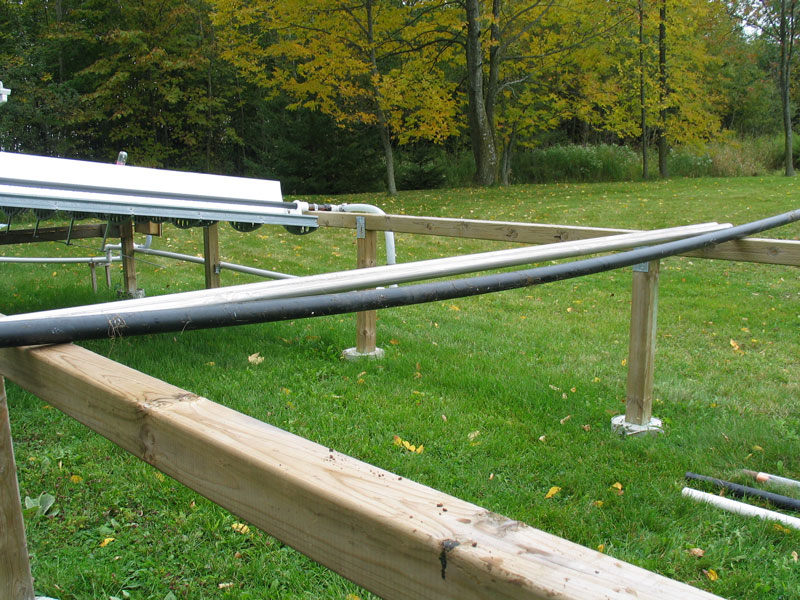
In this picture (click to enlarge) you can see a comparison of black PVC pipe to stainless steel, with one of the solar heaters in the background. The sag in the PVC pipe is readily visible. The tubes in the picture are empty. Normally the 1-1/2 inch pipe used in this installation contains about 10 pounds of water over the length of the span, which makes the sag greater! ABS pipe has a similar problem, although not as severe.
I did a sag test last year using copper pipe (the DWV type, with the thinnest wall) suspended over the span, filled with water, and I found that the sag was less than a millimeter.
It is important to keep the pipe in the focus of the parabollic reflector and it is not possible to do this with the PVC unless it is somehow supported mid-span.
The metal tubes while more expensive are significantly stiffer than the PVC and they span the length of the collector and remain accurately positioned at the focus with no problems.
The second problem with the PVC is what happens to it if the water drains from the system and the PVC receives the focussed heat from the reflector without the cooling effects of the water. In dry tests, the collector tube reaches over 300 degrees F. I did this test with a black painted copper pipe, not PVC. The PVC would likely sag more, or burn. The metal tubes are unaffected by this heat. ABS platic pipe is better at higher temperatures, but the material is white and would require a coating to improve thermal absorption.
Finally, the PVC pipe does not have as good thermal conductivity as metal. Not only is plastic not as good a conductor of heat, but the wall thickness is significantly more than the metal for a given pipe size, further impeding solar heat transfer to the water.
I prefer metal pipe over plastic for the collector tubes for all the above reasons.